

“Getting found online” used to mean one thing, which is to rank at the top of Google. That’s not the case anymore.
Patients now ask ChatGPT, Gemini, Perplexity and Google’s own AI Overviews the same questions they used to type into a search bar. The answer patients get back often decides who they call first.
For anyone running healthcare marketing in Australia, this isn’t a future trend to watch. It’s already changing who gets the phone call. Here’s what’s actually different, what the data says, and what to do about it.
Why This Comparison Matters Now?
The shift happened fast:
- AI tools like ChatGPT and Claude are now cited by patients as an influence on choosing a provider more than Google search itself.
- A year earlier, AI’s influence sat at just 17%. That’s more than double in 12 months.
- Even patients still using Google are reading the AI Overview at the top and stopping there. It’s now the most trusted part of the page, ahead of organic results, the map pack, and ads.
This is no longer a niche behaviour, it’s mainstream and it’s growing every quarter.
How Google Search Still Works for Healthcare Providers?
Google isn’t going anywhere. It’s still where most local, time-sensitive bookings happen.
What Google Still Does Best?
- Shows your location, hours, phone number and reviews instantly through the map pack
- Wins “near me” and “open now” searches
Where it’s Losing Ground?
Informational questions such as “what’s the difference between a crown and a veneer” are increasingly answered for the patient at the top of the page or skipped in favour of asking AI directly.
How AI Search is Changing the Way Patients Find Care?
AI search doesn’t work like a search engine. It works like a conversation.
| Google Search | AI Search |
| Returns a list of 10 links to compare | Returns one direct answer |
| Patient does the comparing | The AI does the comparing |
| Ranking on page 2 still gets you found | Not being mentioned means you don’t exist for that answer |
AI Search vs Google Search: A Side-by-Side Comparison
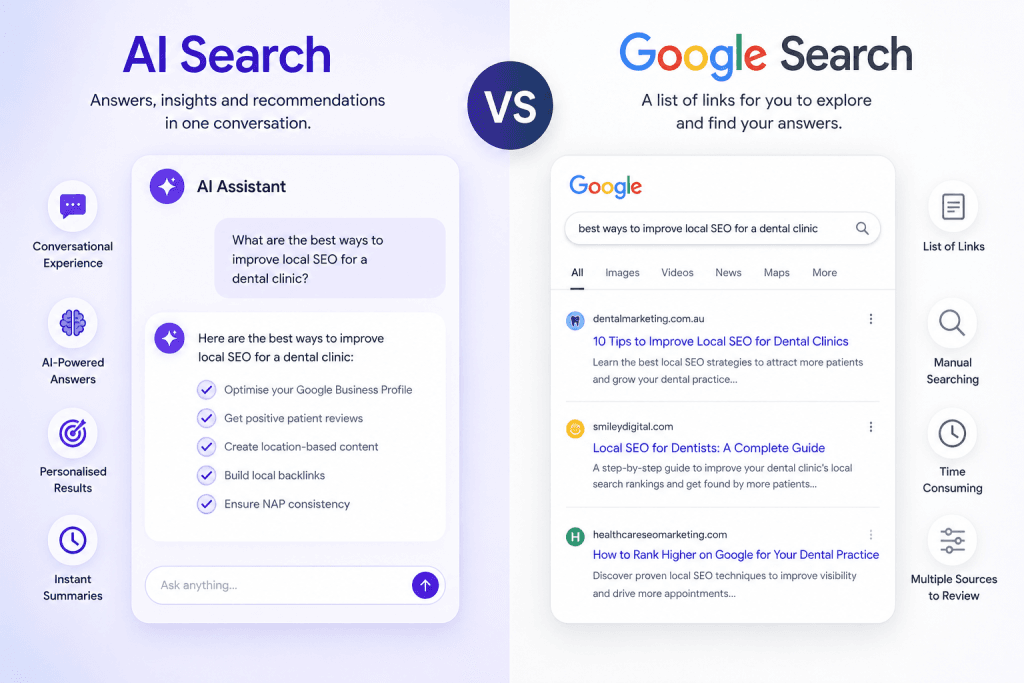
Here are some of the differences between AI search and Google search:
| Factor | Google Search | AI Search (ChatGPT, Gemini, AI Overviews) |
| How results appear | Ranked list of websites, map pack and Google ads. | One synthesised answer, naming a handful of providers. |
| How patients search | Short keywords such as “dentist in Melbourne“. | Patients ask full questions with context. |
| Best for | Time-sensitive, local or “find me now” decisions. | Early research and building trust before a shortlist. |
| Visibility depends on | SEO, Google Business Profile, backlinks and reviews. | Clear content that answers real questions, consistent trusted mentions. |
| How you get chosen | Ranking position, rating, proximity and ad spend. | Being cited in the answer as there’s no page two. |
| Room to hide | Reasonable as your healthcare clinic can still rank in page 2 or 3. | Very little as no mention, no visibility. |
| Trajectory in Australia | Mature, stable, but organic clicks are shrinking. | Fast-growing patient influence, now rivalling Google. |
Why Patients Are Asking AI Before They Ask Google?
Four reasons and none of them are reversing:
- Speed: One direct answer beats comparing ten websites.
- Trust in the format: Most people say AI answers give them a clearer picture even though accuracy on details like addresses or hours isn’t always perfect.
- Wider demographics: Adoption is shifting sharply among 45–60 year olds, a group once considered “Google-first.“
- Better fit for health questions: “Should I see a GP or go straight to a specialist?” suits a conversation, not a list of blue links.
What This Shift Means for Healthcare Marketing in Australia?
Ranking on Google is no longer the finish line. It’s half the job.
Practices that stay visible will be doing this:
- Answer real questions directly: Your healthcare pages should answer the way a patient would actually ask them, not generic keyword copy.
- Keep information consistent everywhere: Website, Google Business Profile, HealthEngine, Healthgrades and review sites, information should be consistent throughout. AI tools pull from all of them.
- Build topical authority: These days, it’s important for you to build authority in the treatments and conditions you want to be known for.
- Don’t drop traditional SEO: As SEO is still the foundation AI search visibility is built on make sure that you use proper SEO strategies.
This dual-channel approach is exactly what a medical marketing agency in Australia should already be building into your strategy.
Staying AHPRA-Compliant Across Google and AI Search
Faster content doesn’t mean fewer rules. AHPRA’s advertising guidelines apply to AI-optimised content the same way they apply to everything else.
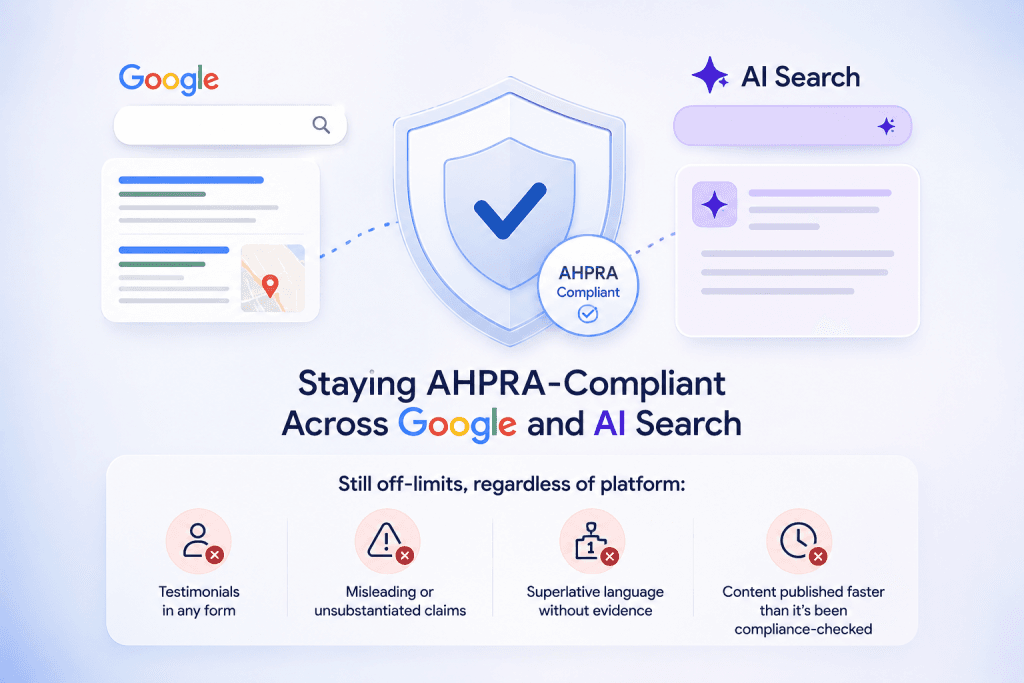
Still off-limits, regardless of platform:
- Testimonials in any form
- Misleading or unsubstantiated claims
- Superlative language without evidence
- Content published faster than it’s been compliance-checked
Never Miss an Enquiry: Why a 24/7 AI Receptionist Matters?
Getting found is half the battle. Answering the call is the other half.
If an enquiry lands after hours, mid-appointment or on a weekend and goes to voicemail, all that visibility work is wasted. Your patient just moves to the next practice.
A 24/7 AI Receptionist closes that gap. It can:
- Answer calls day and night, including weekends
- Capture patient details and common questions
- Book appointments automatically
- Handle multiple calls at once without adding to reception’s workload
- Transfer to a real team member when needed
- Sync directly with your practice CRM
Conclusion
The way patients find healthcare providers has split into two lanes and both matter now.
Google still wins the moment a patient is ready to book, such as location, hours, reviews and a fast local result. AI search is winning the moment before that, when a patient is still deciding who to trust.
If you’d rather have a professional team handle this shift for you, at VIS Healthcare Marketing, we work exclusively with Australian healthcare providers on exactly this. We combine AHPRA-compliant SEO with AI search visibility.
FAQs
Is AI search replacing Google for healthcare?
Not yet. Google still dominates local, time-sensitive searches. AI search is winning the earlier research and trust-building stage of the patient journey.
Do I need to choose between SEO and AI search visibility?
No. AI search visibility is built on top of solid SEO. A fast site, accurate local listings and strong authority signals feed both channels.
How long does it take to see results from AI search optimisation?
Similar to SEO, some improvements show within a few months, but meaningful visibility builds over time as content, structure and authority strengthen.
What happens if a patient calls after hours and no one answers?
In most cases, they call the next practice on the list. A 24/7 AI receptionist prevents that by answering, capturing details and booking appointments around the clock.